
A New Fiscal and Legal Era: Florida’s Sweeping July 1 Statutory Overhaul
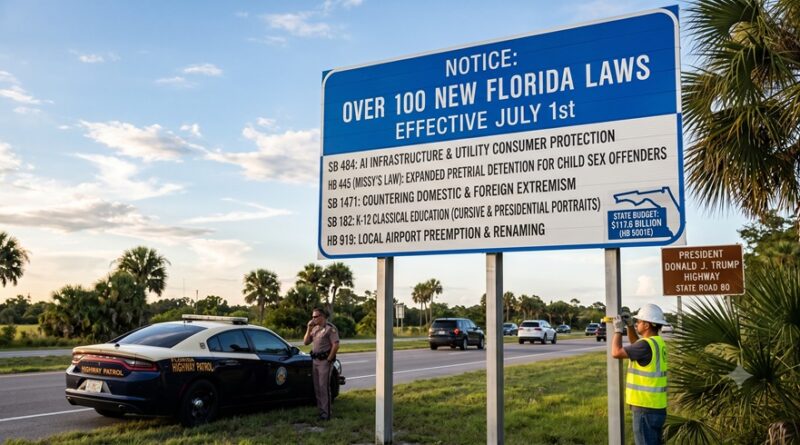
On July 1, Florida officially entered a new fiscal year, triggering the activation of roughly 140 new laws passed during the regular legislative session and a trio of intense special sessions. This sweeping statutory overhaul impacts nearly every facet of life in the Sunshine State, reshaping the state’s multi-billion-dollar budget, expanding public safety definitions, establishing strict parameters around tech infrastructure, and introducing highly publicized symbolic changes.
Governor Ron DeSantis set the stage for this massive legislative rollout just days prior by signing an adjusted $117.6 billion state budget, exercising his line-item veto power to trim approximately $1.6 billion from lawmakers’ initial spending proposals. This final budget actions marked the eighth and final fiscal plan of his administration. Running alongside the state budget is a trio of high-impact bills targeting AI infrastructure, child safety, and international security, establishing a rigid legal framework that will dictate Florida’s trajectory for years to come.
Balancing the Ledger: The Final $117.6 Billion State Budget
The foundation of the July 1 rollout is House Bill 5001E, Florida’s state budget. The finalized $117.6 billion spending plan represents a carefully calculated compromise between legislative ambitions and executive restraint. Governor DeSantis’ line-item vetoes eliminated $810 million in direct local projects and blocked a major $750 million transfer from the state’s main fund into the budget stabilization reserve.
Despite these cuts, the fiscal plan heavily funds critical priorities, including historic investments in K-12 education, state infrastructure, and statewide environmental restoration initiatives. Because Florida law dictates that the state’s fiscal calendar begins on July 1, the immediate implementation of this budget avoids any disruption to state agencies, educational institutions, or active civil infrastructure projects.
The Legislative Trio: AI Infrastructure, Child Protection, and Foreign Countermeasures
While dozens of broad-ranging bills took effect simultaneously, three specific pieces of legislation signed by the governor represent the true ideological and structural heavyweights of this session.
1. Protecting the Grid from the AI Boom (SB 484)
The rapid expansion of artificial intelligence and machine learning has triggered an unprecedented demand for data centers, which require massive amounts of electrical power and water cooling. Under Senate Bill 484, Florida is taking proactive steps to protect everyday consumers from absorbing the infrastructure costs associated with this tech boom.
The law directs the Florida Public Service Commission (PSC) to establish specialized tariffs and service requirements for large-scale data center developers. The core objective is simple: ensure that these high-consumption commercial clients bear the full financial burden of their utility upgrades, explicitly preventing electric and water utility companies from shifting these operational costs onto the general bodies of everyday ratepayers. Governor DeSantis lauded the bill as a critical “first step” toward regulating tech infrastructure without compromising local grid stability.
2. Broadening Child Safety and Pretrial Detainment (HB 445)
Formally known as “Missy’s Law,” House Bill 445 directly restructures how Florida handles individuals accused or convicted of severe child exploitation. The legislation is named in honor of Missy Mogle, a young Florida girl tragically killed by her stepfather, a individual who had previously been convicted of an attempted sex crime against a minor but was permitted to remain out on bail pending his sentencing hearing.
Missy’s Law closes this structural loophole by adding computer pornography and child exploitation violations to the state’s official statutory definition of a “dangerous crime.” Under the new rules, courts are mandated to take a defendant into immediate custody the moment they plead guilty, plead no contest, or are found guilty of a dangerous crime. These individuals must remain detained without the possibility of bond while awaiting formal sentencing.
3. Mitigating Foreign Influence and Countering Domestic Extremism (HB 905 & SB 1471)
In a major defensive regulatory shift, House Bill 905 places severe restrictions on commercial and legal operations involving “foreign countries of concern,” a designation that includes China, Russia, Iran, North Korea, Cuba, Venezuela, and Syria. The law tightens criminal penalties for individuals or corporate entities conducting unauthorized transactions with designated foreign entities. Strikingly, the law extends into family law, prohibiting preplanned adoption agreements or legal surrogacy contracts if any of the involved parties hold citizenship or primary residency in one of these restricted nations.
Complementing this foreign policy strategy is Senate Bill 1471, which empowers the state’s Chief of Domestic Security—housed within the Florida Department of Law Enforcement (FDLE)—to formally designate entities as “domestic terrorist organizations.” Under this law, any group or company so designated faces immediate asset freezing, funding withholding, or total dissolution by the state, while public educational institutions are granted the explicit authority to summarily expel any students linked to these organizations.
Education, Transnational Logistics, and Municipal Preemptions
Beyond the flagship bills, the July 1 statutory rollout contains several provisions modifying local education, transportation identity, and municipal authority.
Classical Expectations and K-12 Athletics
Florida public classrooms are seeing both traditional and structural updates under Senate Bill 182 and Senate Bill 178. School districts are now legally required to display formal portraits of Presidents George Washington and Abraham Lincoln in a highly visible location within every public school building. Furthermore, the legislation explicitly mandates the instruction of cursive writing within elementary school curricula.
For high school sports, coaches are now permitted to receive supplemental compensation financed directly via external booster clubs. Additionally, coaches can legally utilize up to $15,000 annually of their personal funds to pay for their players’ food, transportation, and physical therapy services—provided none of the funds are utilized for recruitment purposes.
High-Profile Infrastructure Renaming
In a highly publicized move, House Bill 919 officially strips local municipalities of their autonomous authority to name major commercial service airports, placing that power under state preemption. The law formally renames Palm Beach International Airport to the “President Donald J. Trump International Airport.”
[State Preemption Realignment]
      │
      ├─► HB 919: Palm Beach International Airport ──► President Donald J. Trump International Airport
      │
      └─► SB 628: State Road 80 (Tri-County)      ──► President Donald J. Trump Highway
The execution of this renaming remains subject to standard Federal Aviation Administration (FAA) compliance and a formal trademark usage agreement with the Trump Organization. Similarly, Senate Bill 628 honors the former president by structurally designating the entirety of State Road 80—spanning Palm Beach, Hendry, and Lee counties—as the “President Donald J. Trump Highway.”
Curbing Municipal Regulatory Power
The broad “Farm Bill” enacted this session severely restricts municipal overreach, banning local cities and counties from enacting ordinances that outlaw or penalize the use of gas-powered lawn equipment, such as commercial leaf blowers. On the environmental front, House Bill 1217 explicitly bars state and local government agencies from executing or enforcing any “net-zero” greenhouse gas emissions frameworks.
Looking Ahead
As these 140 new statutes weave into the daily operations of local law enforcement, school boards, utility providers, and corporate entities, the visual and legal landscape of Florida is poised for an immediate shift. While a separate block of approved bills from the latest legislative session are held back for implementation on October 1 and January 1, 2027, the massive legislative wave that crested on July 1 cements a highly regulated, consumer-insulated, and ideologically distinct foundation for the state’s fiscal future.